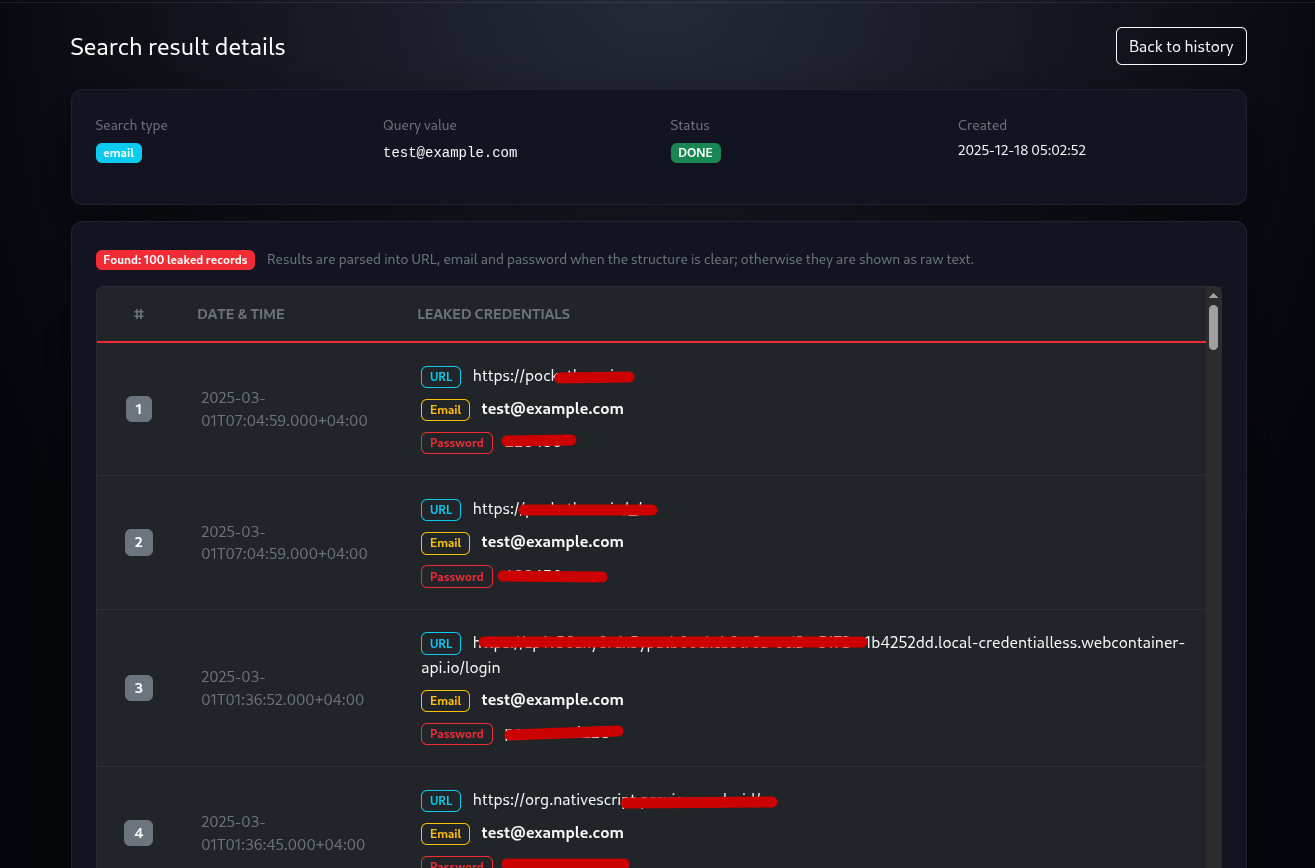
Because Breaches Start Outside the Perimeter
Most security programs are built around internal visibility — logs, endpoints, and network telemetry.
However, real-world incidents show a different pattern:
Attackers usually begin with what is already exposed.
Leaked credentials, hard-coded secrets, forgotten subdomains, third-party breaches, and misconfigured cloud assets often provide attackers with direct access — without the need for exploitation.
LeakWatch was built to continuously detect and track these exposures before they turn into incidents.
What Is LeakWatch?
LeakWatch is RedSide Security’s external exposure monitoring and leak intelligence platform.
It continuously observes open, semi-private, and underground sources to identify when an organization’s data, credentials, or access artifacts become exposed.
Unlike periodic breach checks, LeakWatch operates as a living monitoring system, adapting as your infrastructure and threat landscape change.
Threats LeakWatch Detects
LeakWatch focuses on the types of exposure most commonly used in real attacks:
Credential Exposure
- Employee and administrator email/password leaks
- Credentials from third-party breaches reused internally
- Service and automation account leaks
Secrets & Access Artifacts
- API keys, OAuth tokens, JWTs
- Cloud provider access keys
- Hard-coded secrets in public repositories
- Mobile application secrets
Infrastructure & Asset Exposure
- Forgotten subdomains and test environments
- Public admin panels and internal dashboards
- Exposed configuration files and backups
- Cloud storage exposure indicators
Dark Web & Threat Actor Intelligence
- Data dumps and breach sales
- Company mentions on underground forums
- Access brokering activity
- Early signs of targeting and reconnaissance
Why LeakWatch Is Different
1. Continuous, Not Reactive
Most organizations discover leaks after misuse.
LeakWatch detects exposure at the moment it appears, not after abuse.
2. Context Over Noise
Not every leaked credential is exploitable.
LeakWatch applies:
- Validation checks
- Asset correlation
- Relevance scoring
This reduces false positives and focuses attention on real risk.
3. Built for Action
Every LeakWatch alert includes:
- Exposure type and source
- Potential impact
- Affected assets
- Clear remediation steps
Security teams can act immediately — without additional investigation.
How LeakWatch Fits Into Incident Prevention
LeakWatch enables security teams to:
- Rotate credentials before attackers use them
- Block compromised accounts proactively
- Identify weak third-party security dependencies
- Reduce attack surface over time
- Support breach disclosure and compliance obligations
In many cases, LeakWatch findings prevent incidents that would otherwise reach the SOC.
LeakWatch & Compliance
LeakWatch supports compliance and governance efforts by providing:
- Evidence of continuous monitoring
- Documented exposure timelines
- Proof of early detection and response
- Artifacts suitable for audits and regulators
Relevant for:
- ISO 27001
- SOC 2
- PCI DSS
- GDPR incident readiness
Example: Real-World Attack Prevention
Scenario:
A developer’s email appears in a third-party breach. The same password is reused for an internal admin panel.
Without LeakWatch:
Attackers test the credential, gain access, escalate privileges, and remain undetected for weeks.
With LeakWatch:
The exposure is detected externally, credentials are rotated, and access is blocked before any login attempt occurs.
Designed for Modern Environments
LeakWatch is built for:
- SaaS platforms
- Cloud-native infrastructure
- Distributed teams
- API-driven services
- Organizations with complex third-party dependencies
It evolves as your environment evolves.
Part of the RedSide Security Ecosystem
LeakWatch does not operate in isolation.
Its findings feed directly into:
- Threat Lab for validation and risk analysis
- SOC as a Service for continuous monitoring and response
This ensures that exposure intelligence becomes operational security, not just information.
Final Thoughts
Security incidents rarely start with exploitation.
They start with exposure.
LeakWatch gives organizations the visibility to detect exposure first, respond faster, and reduce risk before damage occurs.
External exposure is inevitable.
Being unaware of it is optional.
Link: LeakWatch


