RedSide Security has officially released ReD-Pot Community Edition, a free, open-source deception and honeypot platform designed to detect attackers after they have gained access to an organization's internal network.
Unlike traditional internet-facing honeypots that primarily capture external scanning activity, ReD-Pot focuses on internal network discovery, credential theft, and lateral movement.
The platform deploys realistic decoy servers, plants traceable honeytokens, monitors attacker interactions, and reconstructs attack paths through a centralized security dashboard.
ReD-Pot Community Edition 1.0.0 is available on GitHub under the MIT license.
GitHub: github.com/RedSideSecurity/ReD-Pot
Why We Built ReD-Pot
Firewalls monitor network boundaries. Endpoint Detection and Response (EDR) solutions monitor endpoint activity. Security Information and Event Management (SIEM) platforms correlate logs and security events.
However, detecting an attacker who has already established an initial foothold remains challenging.
Once inside an organization, attackers may use legitimate administration tools and valid credentials to explore the network.
Typical post-compromise activities include:
- Enumerating internal servers and network services
- Discovering Active Directory users and groups
- Searching shared folders for sensitive information
- Extracting credentials from configuration files
- Performing password spraying
- Targeting service accounts through Kerberoasting
- Moving laterally through SMB, RDP, or SSH
These activities can blend into legitimate administrative traffic, particularly in large enterprise environments.
ReD-Pot introduces deliberately placed deception assets into that environment.
A legitimate employee should have no business interacting with a decoy server or using credentials planted exclusively as bait.
When such activity occurs, it provides security teams with a valuable signal that warrants investigation.
What Is ReD-Pot?

Figure 1. ReD-Pot overview dashboard displaying internal network topology and live security incidents.
ReD-Pot is an internal-network deception platform developed by RedSide Security.
It creates realistic server environments that imitate an organization's infrastructure.
Instead of deploying generic honeypots with easily recognizable default configurations, ReD-Pot generates decoys using an organization's domain, naming conventions, users, and realistic files.
The platform supports five decoy server roles.
| Decoy Role | Simulated Environment | Security Monitoring |
|---|---|---|
| Windows File Server | Finance, HR, and IT file shares | SMB enumeration, file access, credential discovery |
| Windows Domain Controller | Active Directory, LDAP, Kerberos, DNS, SYSVOL | Domain enumeration, authentication attempts, Kerberoasting |
| Linux Web Server | Webmail, helpdesk, or intranet | HTTP probing, authentication attempts, suspicious web activity |
| FTP / Backup Server | Backup files and database dumps | FTP access, credential use, file retrieval |
| Linux DNS Server | Internal corporate DNS | DNS enumeration and zone-transfer attempts |
Each role operates as a decoy rather than a genuine production server.
The objective is to attract suspicious interactions without exposing real business data or credentials.
Honeytokens: Turning Stolen Credentials Into Detection Signals

Figure 5. Decoy server inventory showing planted credentials, bait documents, and honeytoken hits.
One of ReD-Pot's most important capabilities is its honeytoken-based detection system.
A honeytoken is a deliberately planted piece of information that appears valuable but exists solely to detect unauthorized access or use.
ReD-Pot generates realistic bait artifacts such as:
- Password files inside IT shares
- SSH private keys
.envconfiguration files- Database dumps containing fake credentials
- Group Policy Preferences passwords
- Kerberoastable Active Directory service accounts
- Documents that generate a callback when opened
Each bait is assigned a unique identifier.
This allows ReD-Pot to associate the use of a credential or document with the location where it was originally planted.
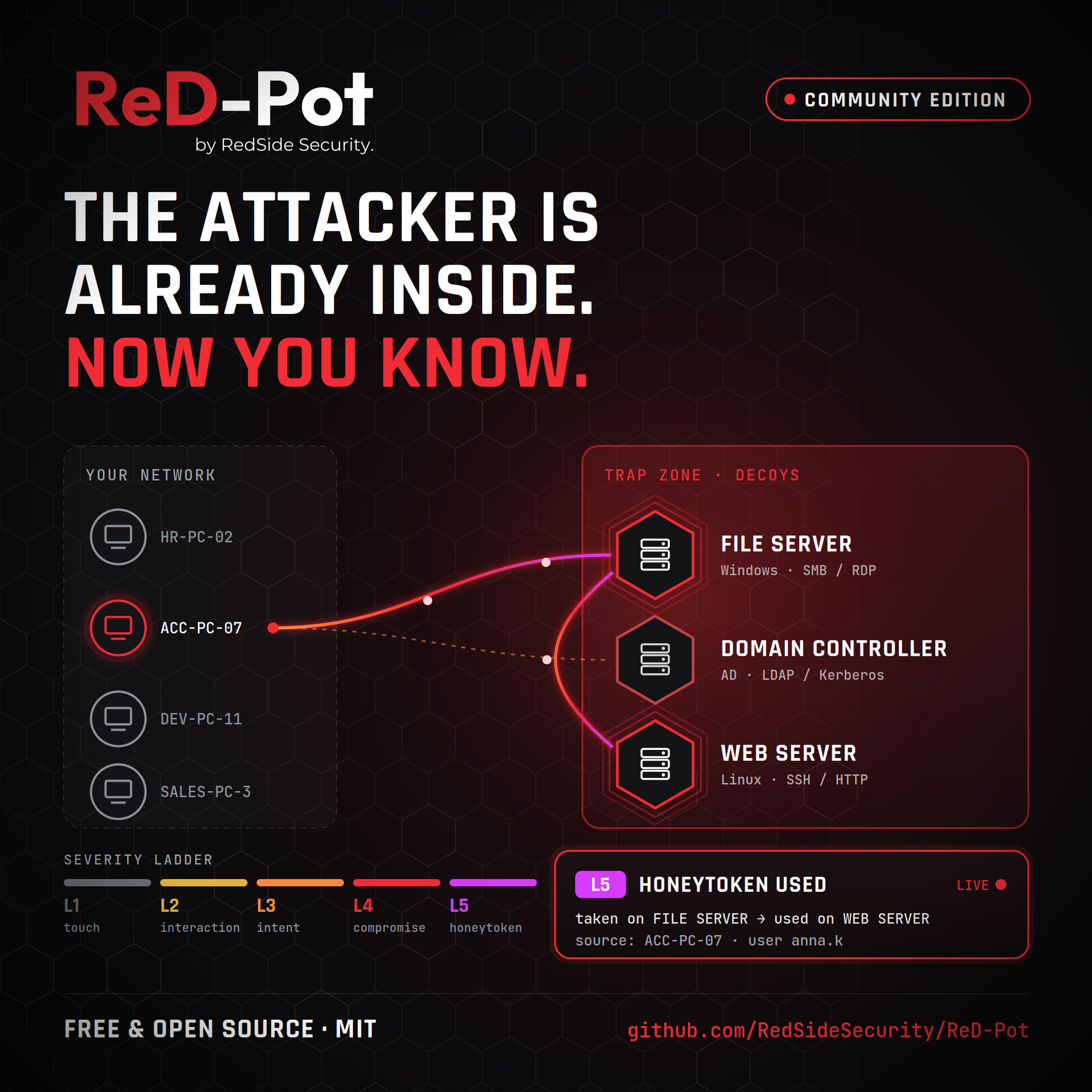
Example: Detecting Credential Theft and Lateral Movement

Figure 2. Attack path reconstruction linking source hosts, decoy servers, and honeytoken interactions.
Consider a simulated attacker who gains access to a workstation.
The attacker discovers a Windows file server named RS-FS-01 and enumerates its IT share.
Inside that share, the attacker finds a password file containing credentials that appear to provide access to another server.
The attacker attempts to use those credentials against RS-WEB-01.
ReD-Pot can correlate these interactions and identify:
- The workstation that accessed the original bait.
- The user identity associated with the recorded activity, when available.
- The server from which the bait was obtained.
- The destination where the bait was subsequently used.
- The sequence of suspicious actions.
Instead of generating disconnected security events, the platform reconstructs a meaningful attack path.
This helps incident responders understand not only that suspicious activity occurred, but also how it progressed.
Attack Severity Classification: From L1 to L5

Figure 3. L5 incident investigation with a detailed event timeline and affected decoy servers.
ReD-Pot uses a five-level severity model to distinguish low-level interactions from stronger indicators of malicious activity.
| Level | Classification | Example |
|---|---|---|
| L1 | Touch | Basic TCP connection or initial network contact |
| L2 | Interaction | Protocol negotiation or routine service interaction |
| L3 | Intent | Port scanning, share enumeration, password spraying, DNS zone-transfer attempts |
| L4 | Compromise | Successful decoy login, sensitive bait file access, or active interaction |
| L5 | Honeytoken | Use of a stolen bait credential or activation of a honeytoken |
The distinction matters because not every network connection should be treated as a security incident.
A single TCP connection to a decoy may be accidental or originate from an authorized scanner.
However, a workstation retrieving fake credentials and attempting to use them against another decoy represents a much stronger signal.
ReD-Pot records meaningful incidents at L3 and above while preserving lower-level interaction data for context.
This severity model helps SOC teams prioritize alerts based on observed behavior rather than raw event volume.
Visualizing Attack Paths Across the Internal Network
ReD-Pot includes a web-based dashboard that provides visibility into suspicious activity across deployed decoys.
The Internal Network Map displays:
- Source workstations
- Internal network segments
- Deployed decoy servers
- Connections between sources and decoys
- The sequence of suspicious interactions
- Severity-based visual indicators
- Honeytoken activations
The map uses different colors to distinguish activity categories, such as interaction, intent, compromise, and honeytoken use.
For example, an analyst may observe a source workstation accessing a file server, enumerating domain services, and subsequently using a planted credential.
These events are connected visually, helping responders understand the progression of the incident.
Incident Investigation and Timelines
ReD-Pot also provides detailed incident views.
Each incident can contain:
- Source IP address
- Workstation name
- Observed user identity
- Targeted decoy servers
- Protocols used
- First and last activity timestamps
- Relevant tools and client identifiers
- Chronological event timeline
Analysts can acknowledge incidents, close them, or mark them as false positives.
The objective is to transform network deception telemetry into actionable investigation context.
Identifying Internal and External Attack Sources

Figure 4. Live external attack activity visualized by source country, network, and severity.
Although ReD-Pot primarily targets internal-network threats, it also supports internet-facing deception deployments.
The platform includes a Live Attack Map for visualizing activity associated with public IP addresses.
Supported views include:
- Geographic distribution of external sources
- Source countries
- Autonomous System Numbers (ASNs)
- Recent attack activity
- Severity classifications
- Live event feeds
Geolocation is performed locally, allowing the platform to operate without relying on a cloud-based enrichment service after installation.
For SOC environments, ReD-Pot also includes a full-screen wall display with attack maps, counters, and a read-only kiosk view.
MITRE ATT&CK Coverage
ReD-Pot's detection capabilities align with several MITRE ATT&CK techniques commonly observed during internal network compromise.
| MITRE ATT&CK | Technique | ReD-Pot Detection |
|---|---|---|
| T1046 | Network Service Discovery | Scanning decoy services and ports |
| T1135 | Network Share Discovery | Enumeration of SMB shares |
| T1087.002 | Domain Account Discovery | LDAP searches and Kerberos user enumeration |
| T1110.001 | Password Guessing | Authentication attempts against decoy services |
| T1110.003 | Password Spraying | Multiple account login attempts |
| T1552.001 | Credentials in Files | Access to planted credential files |
| T1552.006 | Group Policy Preferences | Interaction with planted GPP credentials |
| T1558.003 | Kerberoasting | Ticket requests targeting honey service accounts |
| T1078 | Valid Accounts | Use of bait credentials |
| T1021.001 | Remote Desktop Protocol | RDP activity against decoys |
| T1021.002 | SMB/Windows Admin Shares | SMB authentication and access |
| T1021.004 | SSH | SSH authentication and interaction |
| T1190 | Exploit Public-Facing Application | Suspicious web exploitation attempts |
| T1562.001 | Impair Defenses | Possible sensor tampering or interruption |
These mappings help security teams incorporate deception telemetry into threat-hunting procedures and MITRE ATT&CK-based coverage assessments.
SIEM Integration and Incident Export
ReD-Pot is designed to complement existing security monitoring infrastructure.
Meaningful incidents are written to an alerts.json feed using JSON Lines format.
The repository documents compatibility with standard log-shipping workflows for platforms such as:
- Splunk
- Wazuh
- Elasticsearch / ELK
- Other SIEM platforms that accept structured JSON events
The platform also supports an optional events.json feed containing lower-level events.
Security teams can export incidents and associated alert records for a specified date range through the dashboard or command-line interface.
This makes it possible to preserve findings, correlate them with existing telemetry, and incorporate deception alerts into incident response workflows.
Community Edition does not currently include built-in outbound email, Telegram, or webhook notifications.
Those requirements can be addressed through an external SIEM or log shipper.
Distributed Deception Across VLANs and Offices
ReD-Pot supports a central manager with remote sensors deployed in other network segments.
This allows organizations to place deception assets in different VLANs or offices while monitoring activity from a centralized dashboard.
Remote sensors communicate with the manager through an encrypted, certificate-pinned connection.
According to the project documentation, idle sensor traffic is approximately 0.6 kbit/s.
A credential planted in one location can be recognized when it is used against another participating decoy.
This is particularly valuable for detecting lateral movement across segmented enterprise networks.
Community Edition's three-decoy limit applies across both local decoys and remote sensors.
Lightweight Architecture Without an Elasticsearch Requirement
ReD-Pot uses a lightweight architecture built around Python, SQLite, and Docker.
Unlike deception platforms that require a separate search cluster for basic operation, ReD-Pot does not require Elasticsearch or Kibana.
The published system requirements are:
| Component | Minimum Requirements |
|---|---|
| Operating System | Ubuntu 22.04+ or Debian 12+ |
| Architecture | x86_64 |
| Manager + Decoys | 1 vCPU, 1 GB RAM, 5 GB storage |
| Remote Sensor | 1 vCPU, 512 MB RAM, 3 GB storage |
| Python | 3.8 or newer |
| Container Runtime | Docker, installed automatically when required |
The repository reports approximately 140 MB RAM usage for a manager with two decoys in its measured Community Edition configuration.
Actual resource consumption will vary depending on deployment size, traffic, and configuration.
The platform can operate offline after installation and does not require a cloud account, license server, or outbound telemetry connection.
Security Isolation and Decoy Hardening
Because honeypots deliberately expose services that may attract hostile traffic, isolation is an important architectural requirement.
ReD-Pot's documentation describes several protective controls:
- Decoys operate inside containers.
- Containers use read-only filesystems.
- Decoy processes run as unprivileged users.
- Linux capabilities are restricted.
- The
no-new-privilegesprotection is enabled. - Decoys do not execute attacker-supplied commands.
- Management services use restricted network access.
These controls are designed to reduce the risk of an attacker using a decoy to compromise the underlying manager or reach production systems.
As with any deception environment, organizations should review the deployment architecture, maintain network segmentation, and avoid placing management interfaces directly within untrusted networks.
ReD-Pot Community Edition: Features and Limitations
ReD-Pot Community Edition 1.0.0 is free and distributed under the MIT license.
The edition provides the platform's core deception, detection, visualization, and incident investigation capabilities.
Current limitations include:
| Feature | Community Edition |
|---|---|
| Available decoy roles | 5 |
| Maximum deployed decoys | 3 total |
| Remote sensors | Supported within the three-decoy limit |
| Network interfaces | One decoy per interface |
| Persona customization | Domain and industry configurable; other details generated |
| Custom bait files | Not supported |
| SIEM integration | JSON log feed and export |
| Built-in outbound notifications | Not included |
| SMB support | SMB 2.0.2 and 2.1 |
| Operating system fingerprint | Uses underlying Linux host TCP/IP stack |
| Offline sensor event replay | Not supported |
| License | MIT |
ReD-Pot Enterprise is intended for organizations requiring larger deployments, additional customization, and expanded capabilities.
The repository also identifies planned improvements, including additional decoy roles and threat intelligence export options.
How to Install ReD-Pot Community Edition
ReD-Pot provides an interactive installer for supported Ubuntu and Debian systems.
The basic installation workflow is:
git clone https://github.com/RedSideSecurity/ReD-Pot.git
cd ReD-Pot
sudo ./install.sh
The installer guides administrators through:
- Selecting the management network interface.
- Defining the organization's domain and industry.
- Choosing decoy server roles.
- Assigning interfaces and hostnames.
- Configuring management access.
- Reviewing changes before deployment.
The installation process identifies potential port conflicts and presents a review screen before applying changes.
Important: If a decoy shares the host's management interface, the installer moves SSH to a different port. It may also need to stop services that conflict with the selected decoy ports.
For this reason, administrators should test deployment in an isolated laboratory or dedicated host before using it in a production network.
Refer to the official installation documentation for supported configurations and network-planning requirements.
Installation Guide: ReD-Pot Documentation
How ReD-Pot Complements Existing Security Controls
ReD-Pot is not designed to replace firewalls, EDR, or SIEM platforms.
Instead, it adds a detection capability focused on suspicious interactions with assets that legitimate users should not need.
| Security Technology | Primary Focus |
|---|---|
| Firewall | Network traffic filtering and access control |
| EDR | Endpoint behavior and malicious activity |
| SIEM | Log collection, correlation, and alerting |
| ReD-Pot | Deception-based detection of discovery, credential misuse, and lateral movement |
For organizations building or improving a SOC, deception telemetry can provide additional context during investigations involving internal reconnaissance and credential-based attacks.
A high-confidence honeytoken alert may justify immediate investigation of the originating workstation, account, and related activity.
Open Source and Community Contributions
ReD-Pot Community Edition is available publicly through the RedSide Security GitHub organization.
The project welcomes:
- Bug reports
- Feature suggestions
- Technical feedback
- Documentation improvements
- Pull requests
- Responsible security vulnerability reports
As an open-source project, ReD-Pot allows security professionals to study the implementation and test its behavior in authorized environments.
Conclusion
Attackers who bypass perimeter defenses often need to discover systems, enumerate services, find credentials, and move laterally before reaching their objectives.
ReD-Pot is designed to make those activities more visible.
By combining realistic decoy servers, traceable honeytokens, severity-based incident classification, attack-path visualization, and centralized reporting, the platform helps security teams investigate suspicious behavior inside their networks.
With Community Edition, RedSide Security is making internal-network deception technology available to researchers, students, system administrators, and security operations teams without a commercial license requirement.
Firewalls watch the door. EDR watches the endpoints. ReD-Pot watches the space in between.
Project: ReD-Pot on GitHub
Developer: RedSide Security
Edition: Community Edition 1.0.0
License: MIT
Use ReD-Pot only on networks you own or are authorized to protect.